
How We Support Large-Scale, Measurable Implementation
Most organizations have experienced Motivational Interviewing as a training event. A workshop, a seminar, a two-day certification. Staff leave with awareness — and return to systems that haven’t changed around them.
That is not implementation. That is exposure.
At IFIOC, our role is different. As a motivational interviewing implementation partner, we work with state agencies, health systems, and workforce programs to build the structures that turn training into consistent, measurable practice — across teams, programs, and regions. If you’re considering motivational interviewing as part of an RHTP grant or as part of your ongoing quality improvement, the question is not whether to train. It is whether your system is built to sustain what training starts.
This framework is how we answer that question. Start a conversation →
What Implementation Actually Requires
For state and multi-site initiatives, the measure of success is not whether staff attended a training. It is whether the approach:
- Is being used consistently in practice across providers and settings
- Is producing measurable improvements in engagement and outcomes
- Is sustainable beyond the initial rollout period
This level of consistency doesn’t happen through training alone. It requires an implementation partner who understands how complex systems work — and how to build MI into the fabric of how they operate, not just into a curriculum. See how this has produced results in our case studies.
A Statewide Rollout Model That Builds Consistency Over Time
Large-scale implementation begins with partnership and planning.
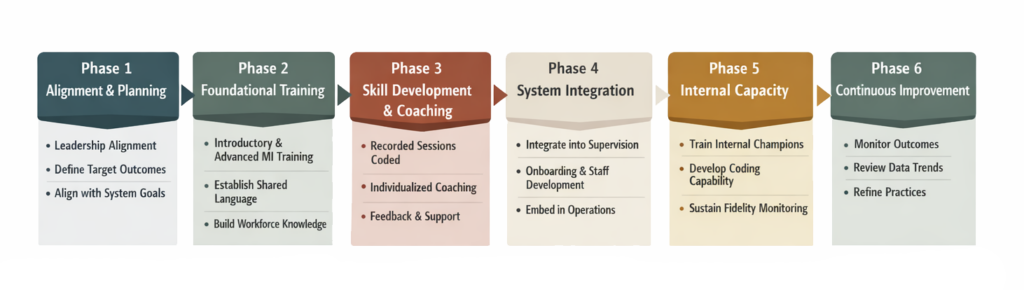
We work with system leadership to align Motivational Interviewing with the outcomes your organization is already accountable for, rather than introducing it as a standalone initiative. A typical rollout as a motivational interviewing implementation partner includes five phases:

1. Leadership alignment

2. Foundational training
3. Skill development
4. Integration into systems
5. Capacity development
Learn more about Training to Fidelity →
View Case Studies →
Start a Conversation →
Implementation Phases
1. Leadership alignment
Before any training begins, we work with leadership to clarify:
- What outcomes matter most
- Where engagement or consistency challenges exist
- How Motivational Interviewing can support existing priorities
This ensures implementation is tied to system goals from day one — not bolted on afterward.
2. Foundational workforce training
We provide introductory and advanced training across relevant teams and roles:
- Establishing a common language for communication
- Introducing core principles and practical application
- Ensuring accessibility across disciplines
At this stage, training creates a foundation—but not yet consistency.
3. Skill development through practice and feedback
This is where implementation diverges from training. Practitioners begin submitting recorded interactions, which are:
- Reviewed using structured coding methods
- Used to provide individualized feedback
- Supported through ongoing coaching
This is the work that moves competency from the training room into the field. Learn how we measure this through our Training to Fidelity approach.
4. Integration into organizational systems
As skill develops, Motivational Interviewing is integrated into existing structures, including:
- Supervision and performance conversations
- Onboarding and new staff training
- Continuing education and professional development
This shifts MI from something staff use when they remember it to something reinforced as part of how the organization operates day to day.
5. Internal capacity development
Over time, organizations build their own capacity to sustain the work:
- Training internal MI champions
- Developing internal coding and coaching capacity
- Supporting leaders in reinforcing the approach
The goal is to reduce reliance on external support while maintaining fidelity and consistency across the system.
Measuring Whats Actually Happening



At the center of this framework is a principle that separates implementation from training: we measure what is happening in practice, not just what was taught.
To support this, we developed the Motivational Interviewing Competency Assessment (MICA) — a validated tool that evaluates observable communication behaviors associated with effective MI. This allows organizations to move beyond self-report and into measurable data.
Baseline measurement of workforce skill
Structured coding of recorded interactions
Individualized coaching based on coding results
Tracking skill development over time
This is motivational interviewing quality assurance in practice — not a checkbox, but an ongoing measurement and feedback system that gives state agencies the data they need to manage implementation and report on outcomes with confidence.
MICA-AI
To support scale across larger systems, we also incorporate MICA-AI — enabling analysis of higher volumes of interactions, more timely feedback to staff, and broader system-level insight into implementation progress across regions and programs.
For state agencies working with a motivational interviewing implementation partner, this level of visibility is what makes outcomes defensible — not just reported. See how this played out in our Washington State DVR case study, where federal performance outcomes rose from 57% to 120%.
Continuous Quality Improvement, Not One-Time Training
When fidelity is measured over time, MI stops being a training topic and becomes part of a continuous quality improvement process. Organizations can begin to monitor:
- Changes in workforce skill and competency over time
- Patient or client engagement indicators
- Program completion and adherence rates
- Performance metrics tied to organizational and funding goals
This creates a feedback loop where improvements in communication can be examined alongside improvements in outcomes — clarifying not just whether MI is being used, but whether it is making a measurable difference. This is the standard that federal programs, including RHTP initiatives, increasingly require. Explore how this connects to our work in behavioral health, chronic disease management, and disease prevention.
Sustainability Beyond Initial Training
The most common concern we hear from state administrators is sustainability. Training can be completed — but without structure embedded in the system, implementation fades. Staff turns over. Priorities shift. The skills don’t hold.
We approach sustainability as something built into the system from the beginning, not added at the end:
- Developing internal MI champions who can support ongoing use
- Establishing internal coding and coaching capacity
- Integrating MI into supervision and staff development structures
- Incorporating fidelity measurement into existing quality improvement processes
This allows organizations to continue strengthening implementation after the initial rollout — without restarting from zero each time circumstances change.
A Practical Implementation Partner
Large-scale implementation carries real constraints — limited time and staff capacity, multiple stakeholders with competing priorities, and the need for outcomes that are measurable and defensible to funders and administrators.
Our role as a motivational interviewing implementation partner is to work within those constraints, not around them:
- Aligning with your existing systems and accountability structures
- Building consistency across teams and regions without disrupting operations
- Providing ongoing visibility into progress so you can report with confidence
- Ensuring that training is not an endpoint, but the start of sustained improvement